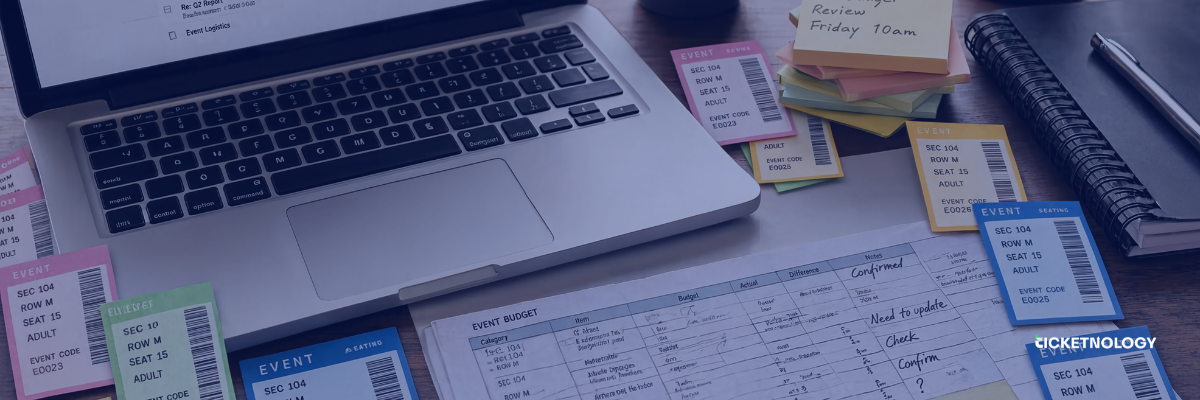
Ask five people at your company who owns employee ticket requests, and you’ll likely get five different answers. Marketing thinks it’s Operations. Operations thinks it’s whoever holds the season tickets. HR assumes IT handles the intake form. And somewhere in the middle, an admin is quietly managing it all through a shared inbox and a spreadsheet nobody else can find.
This isn’t a staffing problem. It’s a process problem — and it’s more common than most companies admit.
Employee ticket requests sit in an awkward spot. They’re not big enough to justify a dedicated system, but frequent enough to create real friction. A few dynamics make this worse:
No clear owner. Ticket access often gets assigned informally — “just ask Sarah” — with no defined process behind it. When Sarah goes on vacation, the whole system stalls.
No visibility into who asked, when, or why. Requests come in through Slack, email, and hallway conversations. There’s no single record of who received a ticket, for which event, or how that decision was made.
No consistent criteria. Without clear rules, ticket distribution can start to look arbitrary — which creates friction between employees and puts managers in the uncomfortable position of explaining decisions they can’t fully account for.
No connection to business value. Companies can rarely say whether employee ticket usage is driving retention, morale, or referrals. The tickets go out. What comes back is unclear.
None of this makes the process someone’s top priority — which is exactly why it never gets fixed.
The costs here are quieter than a blown budget, but they add up:
A Ticket Booth workflow replaces the guesswork with a single intake point — one place to request, approve, and track every ticket, with a clear record of who owns each step.
Fixing this doesn’t require a massive overhaul. It requires assigning three things that are usually missing: a process, a decision-maker, and a record.
1. One intake channel. Every request — regardless of department — should go through the same system, not a mix of email threads and direct messages.
2. Clear approval criteria. Define who qualifies, how often, and based on what (tenure, performance recognition, team events). Written criteria remove the guesswork and protect managers from ad hoc judgment calls.
3. A single source of truth. Every request, approval, and ticket assignment should live in one place — searchable, reportable, and visible to whoever needs it.
This is where a centralized platform earns its place. Instead of a spreadsheet that only one person understands, Ticket Booth gives teams a structured request-to-approval flow that anyone can pick up, audit, or hand off.
Approving a request is only half the job. The other half is making sure the ticket actually gets used, and that unused inventory doesn’t just disappear into a drawer.
Companies with mature ticket programs build in a second layer:
This is the difference between a process that just distributes tickets and one that actually manages them.
Employee ticket programs also tend to compete for the same budget line as client hospitality, with no clear separation between the two. That makes it hard to answer a simple question: how much are we actually spending on internal use versus external relationship-building?
Ticket Pass solves this by giving finance and operations teams a dedicated view into budget allocation — so employee ticket spend is tracked on its own line, not buried inside a broader hospitality budget nobody can fully explain.
As football season ramps up and client entertainment budgets tighten around it, employee ticket requests tend to spike right alongside client demand — often competing for the same limited inventory. Companies that haven’t clarified ownership by then end up making rushed, inconsistent calls under pressure.
The fix isn’t complicated. It’s a defined process, a clear owner, and a system that keeps track of the details so no one has to reconstruct them from memory every time a request comes in.
Employee ticket requests don’t need to be a recurring headache passed between departments. With the right structure in place, they can run on autopilot — clear criteria, one system of record, and full visibility into who’s using what.
If your team is still managing this through email and spreadsheets, now is the time to fix it before fall event season hits full speed.
Book a demo to see how Ticketnology gives your team one place to manage every ticket request — from intake to approval to usage.
Looking for more information or want to schedule a free demo? Let’s chat!
By submitting this form you agree to be contacted and receive additional communication, including emails from Ticketnology.